Plasticity for Structural Engineers

Chapter 2: Yield and Failure Criteria

In Chapter 1, we have discussed the characteristics of the uniaxial behavior of a material, introducing some important concepts in plasticity theory for the uniaxial case. The main task of the subsequent chapters is to generalize these concepts to a combined state of stress. This chapter deals with the limits of elasticity and the limits of strength under all possible combinations of stresses. Before we proceed to this subject, an analysis of the state of combined stresses is first introduced to provide the necessary background for the subsequent study.

2.1 Stress

2.1.1 Stress at a Point and the Stress Tensor

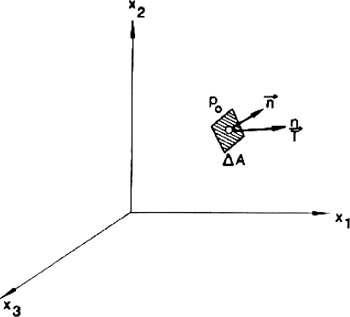
As we know, stress is defined as the intensity of internal forces acting between particles of a body across imaginary internal surfaces. Consider a surface area ? A passing through a point P 0 with a unit vector n normal to the area ? A as shown in Fig. 2.1. Let F n be the resultant force due to the action across the area ? A of the material from one side onto the other side of the cut plane n. Then the stress vector at point P 0 associated with the cut plane n is defined by


Figure 2.1: Stress vector at point P 0 associated with cut n.

The state of stress at a point is defined as the totality of all stress vectors at that point.

Since we can make an infinite number of cuts through a...

UNLIMITED FREE
ACCESS
TO THE WORLD'S BEST IDEAS

SUBMIT
Already a GlobalSpec user? Log in.

This is embarrasing...

An error occurred while processing the form. Please try again in a few minutes.

Customize Your GlobalSpec Experience

Category: Synthetic Fibers and Fabrics
Finish!
Privacy Policy

This is embarrasing...

An error occurred while processing the form. Please try again in a few minutes.