Principles of Applied Reservoir Simulation

The literature contains many derivations of the equations describing fluid flow in porous media. Consequently, only a brief discussion will be presented here. We begin by introducing the continuity equation, and then present some important sets of fluid flow equations that are commonly used to model hydrocarbon reservoirs.
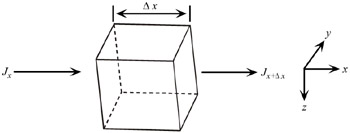
The continuity equation can be derived by considering the flow of fluid into and out of a single reservoir gridblock (Figure 9-1). Let the symbol J denote fluid flux. Flux is defined as the rate of flow of mass per unit cross-sectional area normal to the direction of flow, which is the x direction in the present case. Assume fluid flows into the gridblock at x ( J x) and out of the gridblock at x + ? x ( J x + ? x). By conservation of mass, we have the equality:
If the gridblock has length ? x, width ? y, and depth ? z, we can write the mass entering the gridblock in a time interval ? t as
| (9.1) | |
where we have generalized the equation to allow flux in the y and z directions as well. The notation ( J x) x denotes the x direction flux at location x, with analogous meanings for the remaining terms.
Corresponding to mass entering is a term for mass exiting...