Server Architectures: Multiprocessors, Clusters, Parallel Systems, Web Servers, and Storage Solutions

The objective of this chapter is to analyze and compare architectural options for servers and look at the architecture of database management systems. A DBMS has a privileged relationship with data storage (magnetic disks), broken down into two areas: data management and the caching of data. The nature of the interconnect between system and disk whether it be a single system, an SMP, or a multinode system such as a cluster or MPP provides a further dimension of characterization alongside the architectural choices. DBMS vendors have made architectural choices; we will examine these choices, along with their characteristics and also look at the architectures of selected parallel databases.
We will conclude the chapter with a look at applications characteristics and the choice of architecture with respect to scalability.
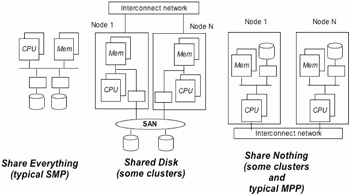
We can distinguish three major classes of architecture in the area of system-disk interconnect. Figure 8.1 illustrates these options.
The diagram shows the three main architectural choices as regards disk connection. There is a fourth possibility, of sharing memory between nodes. This is the approach used by the IBM Sysplex design, a mainframe cluster system covered in Chapter 5.
In the Share Everything approach, all the processors in the system run under the control of exactly one copy of the operating system, and an I/O operation can be initiated by any processor to any disk. This approach is typical of SMP systems (symmetrical multiprocessors).
The Share Nothing architecture has each node...