Turbo Coding for Satellite and Wireless Communications

2.4: Applications of Parallel Concatenated Turbo Codes

2.4 Applications of Parallel Concatenated Turbo Codes

Turbo code, due to its excellent error correcting capability, has received much attention world wide and has been adopted by 3rd generation (3G) mobile communication standards such as 3GPP ( 3rd Generation Partnership Project), UTMS ( Universal mobile Telecommunication Service), and CDMA2000 ( Code Division Multiple Access 2000).


Figure 2.10: Multiple Parallel Concatenation Codes

2.4.1 Turbo Codes in 3GPP

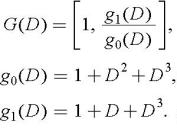
The turbo coding scheme in 3GPP standard [37] is a PCCC with two 8-state constituent encoders and an internal interleaver. The coding rate of the turbo encoder is 1/3. The structure of the turbo encoder is illustrated in Figure 2.11. The transfer function of the 8-state constituent code for PCCC is:


Figure 2.11: Structure of Rate 1/3 3GPP Turbo Encoder (dotted lines apply for trellis termination only)

The initial value of the shift registers of the 8-state constituent encoders shall be all zeros when starting to encode the input bits.

Output from the turbo encoder is


where x 1, x 2, , x K are the bits input to the turbo encoder; K is the number of bits; Z 1, z 2, , z K and z' 1, z' 2, , z' k are the bits output from first and second 8-state constituent encoders, respectively. The bits output from the internal interleaver are denoted by x 1, x 2, , x

UNLIMITED FREE
ACCESS
TO THE WORLD'S BEST IDEAS

SUBMIT
Already a GlobalSpec user? Log in.

This is embarrasing...

An error occurred while processing the form. Please try again in a few minutes.

Customize Your GlobalSpec Experience

Category: Error Correction Chips
Finish!
Privacy Policy

This is embarrasing...

An error occurred while processing the form. Please try again in a few minutes.