The Unified Process Construction Phase: Best Practices for Completing the Unified Process
Dozens of magazine articles about the third phase of the Unified Process, which encompasses analysis, design, and configuration management.
 TABLE OF CONTENTS
 The purpose of the Implementation workflow is to write and initially test your software. During the Construction phase, your implementers (your programmers) will focus on several key activities that are mostly indicated in Figure 5.1 which depicts the solution of the Program process pattern (Ambler, 1998b). Programmers need to invest the time to understand your design model, a key artifact of the Analysis and Design workflow (Chapter 4), and to work with your modelers to ensure that their source code and the design model stay synchronized. They document their source code, prepare it for inspections, write source code, optimize it, reuse existing code (reuse management is supported by the Infrastructure Management workflow discussed in Chapter 3), integrate their code, and build their software.
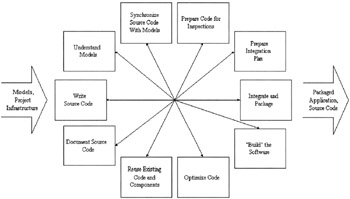
There is more to the Implementation workflow than simply writing source code.
There is more to the Implementation workflow than just the programming-related activities of Figure 5.1 initial testing and validation of your source code are also key activities. In Figure 5.2 you see a depiction of the Full Lifecycle Object-Oriented Testing (FLOOT) process pattern (Ambler, 1998a; Ambler, 1998b; Ambler, 1999) for testing and quality assurance, indicating techniques that can be applied to both the Implementation and Test workflows. Although testing and quality assurance go hand-in-hand, they are two distinct tasks. The purpose of testing is to determine whether or not you built the right thing, and the purpose of quality assurance (QA) is...