Vehicle Propulsion Systems: Introduction to Modeling and Optimization

In this chapter, standard IC-engine-based propulsion systems are analyzed using the tools that will be later applied for the optimization of more complex powertrains. The main components of IC-engine-based propulsion systems are the engine and the gear box. Clutches or torque converters, which also are part of such a powertrain, are needed during the relatively short phases in which the engine must be kinematically decoupled from the vehicle. As shown in the first section of this chapter, in the context of this book the engine may be described by an engine map and two normalized engine variables. The second section shows how the gear ratios must be chosen to satisfy drivability requirements. Once these two components and the main vehicle parameters are specified, estimations of the fuel consumption can be made using any of the methods introduced in the previous chapter. The third section of this chapter includes two examples of such an analysis.
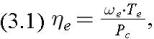
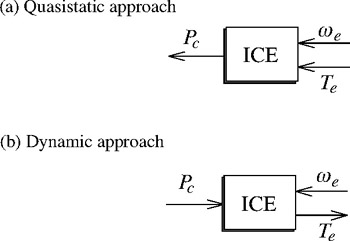
As mentioned in the previous chapter, two different descriptions of the power-train elements are used in this text: the quasistatic and the dynamic formulation. For IC engines, the corresponding input and output variables are shown in Fig. 3.1. The thermodynamic efficiency of such a device is defined by
where ? e is the engine speed, T e the engine torque, and P c the enthalpy flow [1] associated with the fuel mass flow
where H l is the fuel's lower heating value.