Advances In Coastal And Ocean Engineering: Interaction of Strong Turbulence with Free Surfaces, Volume 8

8: Breaker toe dynamics

8 Breaker toe dynamics

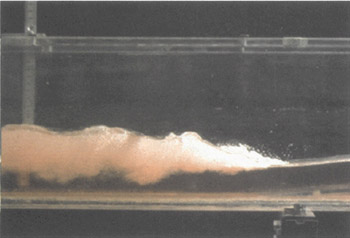
The masses of water falling, tumbling and sliding down the front of a spilling breaker or bore fall onto the smooth incoming water at the leading edge of the breaker, which is where the major generation of turbulence takes place (see figure 6). Traditionally this is usually envisaged as a "roller" riding on the front of a wave meeting the smooth water at its foot. Peregrine and Svendsen (1978) pointed out, in a paper that stimulated or informed a number of experimental measurements (Battjes and Sakai 1981; Stive 1984) that the turbulent flow in a spiller can not easily be separated into a "roller" and the rest. There is a stream of turbulence initiated at the foot of the spiller, from which a roller can only be divided once mean streamlines are determined. Also the fluctuating velocities are just as large as the mean velocities. Hence, here, we do not use the term "roller", though the concept is useful in indicating forward flow in the surface layer down the face of a breaker. We use "breaker" instead. We are keen to be able to model unsteady waves, and for such waves there is then no unambiguous way of determining a separating mean streamline to define a roller's boundary.


Figure 6: Photograph of a hydraulic jump. This is the same flow as shown in Part 1 figure 5, but in this case there was a layer of tiny bubbles on top of the water entering the breaker.

UNLIMITED FREE
ACCESS
TO THE WORLD'S BEST IDEAS

SUBMIT
Already a GlobalSpec user? Log in.

This is embarrasing...

An error occurred while processing the form. Please try again in a few minutes.

Customize Your GlobalSpec Experience

Category: Circuit Breaker Test Equipment
Finish!
Privacy Policy

This is embarrasing...

An error occurred while processing the form. Please try again in a few minutes.