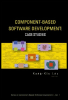
Component-Based Software Development: Case Studies
SUDIPTO GHOSH [1]
Computer Science Department, Colorado State University
Fort Collins, Colorado 80523, USA
ghosh@cs.colostate.edu
ADITYA P.MATHUR [2]
Department of Computer Sciences, Purdue University
West Lafayette, Indiana, 47905, USA
apm@cs.purdue.edu
Abstract. We focus on the issues related to the testing of component-based software that conforms to the CORBA 3 standard. CORBA 3 is a standard for Distributed Component Computing (DCC) middleware and is similar to Enterprise Java Beans (EJB). The specifications for DCC middleware usually offer a set of services, such as security, transaction and persistence. Testing DCC middleware and applications requires testing the services and components used to build these applications. Such testing raises several challenging issues. We report on the application of fault-based testing techniques such as interface mutation and fault injection testing to CORBA-based software and discuss their application to software conforming to other component models.
[1]All correspondence regarding this chapter may be sent to Sudipto Ghosh.
[2]Aditya P.Mathur s research was supported in part by NSF award CCR-9102331 and a grant from Telcordia Technologies and the Software Engineering Research Center.
Software enables the development of increasingly ambitious, safety-critical applications that are used in several areas. Component-based software is gaining popularity in the software industry. Distributed Object Computing (DOC) middleware such as Microsoft s DCOM [Lewandowski (1998)] Sun Microsystem s Java RMI [Downing (1998)] and the Object Management Group s CORBA [OMG (1995)] has now evolved into Distributed Component Computing (DCC). Microsoft s .NET, Sun Microsystem s Enterprise Java Beans (EJB) [Matena et al.