Computational Bioengineering: Current Trends and Applications
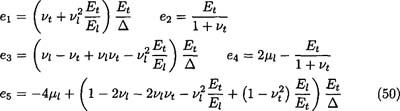
We limit to elastic solids subject to conservative external forces and dry frictional contact. Let ? be the strain energy of B. As an illustration, the constitutive laws of transversely isotropic bone are defined by [15]:
in which
is the structural tensor (m: transverse isotropy direction) and where the elastic coefficients may be related to elastic constants [16]:
where
. The same relations hold for B ? but, constitutive equations may be simplified if B ? is homogeneous and isotropic.
For deriving the (quasistatic) equations governing thermocontact, we proceed step by step. First, for an elastic solid B, the total energy ? ( u) is equal to the internal energy minus the external potential energies
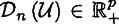
The unconstrained minimization problem would be characterized by the necessary condition (equilibrium equation of B) ? w ? ( u) = 0, ? w ? W, W space of kinematically admissible virtual velocity. Assuming now that B is constrained by unilateral contact on some part of its boundary, we assume dicretized for simplifying (Fig. 1). In presence of inequality constraint
( p-times), minimization problem can be reformulated into a nonconstrained minimization by adding the indicator function to the total energy:
The solution of the nondifferentiable problem can be characterized by calculating the (sub)-derivative to give (necessarily condition of extremality):
For two elastic solids subject to conservative external loads,
includes the two...