Finite Size Effects in Correlated Electron Models: Exact Results

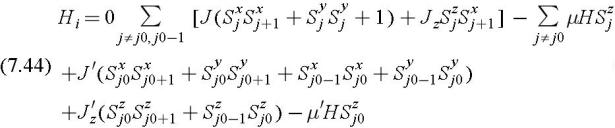
In the previous section we considered characteristics of magnetic impurities in isotropic XY spin- chains. Those studies are relatively easy because the reader knows that Hamiltonians of spin- XY chains in the transverse magnetic field can be exactly mapped onto Hamiltonians of quadratic forms of Fermi operators (by using the Jordan Wigner transformation). However, a nonzero Ising component, J z ? 0, as the reader knows from Chapter 2, introduces an interaction between Jordan Wigner fermions, and we needed a more sophisticated approach, the Bethe ansatz. Is it possible to study exactly, e.g., a Heisenberg Ising chain with an impurity, similar to the one of the previous section? It is easy to check that the Hamiltonian
cannot be diagonalized by using the Bethe ansatz. The reason is very simple: the two-particle scattering matrix of the system with the Hamiltonian Eq. (7.44) does not satisfy Yang Baxter relations, which are necessary conditions to apply the Bethe ansatz scheme, as we showed in Chapter 5. Moreover, the reader saw in Chapter 6 that the only possibility to introduce a local magnetic field (a local potential) is to apply it to edges of an open quantum chain, to preserve the Bethe ansatz integrability. Hence, at least from this perspective, the reader already knows how impurities, which can be described only by the action of a local magnetic field (or a local potential), behave. Nonetheless, the question appears: can one consider inhomogeneous quantum chains, in which a coupling between...