Handbook of Polymer Foams

Over the years, FPF equipment and chemicals have evolved together. Current technology allows manufacturers to produce higher quality foams with less environmental impact and greater economy than ever before. New foam grades are now available that could not be made only a few years before, and that statement is likely to remain true far into the future.
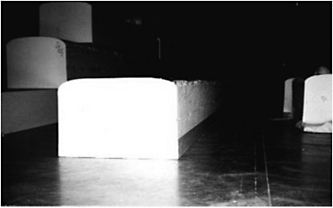
There are two main types of manufacturing equipment: slabstock machines that produce large, continuous blocks of foam (see Figure 5.4), and moulding machines that produce discrete parts which are cured in the shape and size of the mould. Both of these have three main systems. The first is the tanks, pumps, and pipes that store, meter and pump the raw materials, the second is the mix head, and the third takes the liquid pre-foam away from the mix head and provides the space for it to rise and cure.
Moulded foam equipment is designed to accurately dispense relatively small amounts of liquid into each mould, so the feed tanks and delivery system are normally smaller and less complicated than those seen in a slabstock machine. A moulder may have dozens of machines, with each one running a few formulations. Additives are usually pre-blended and only 2-4 streams actually enter the mix head [40]. This is very different to slabstock machines which pour many different grades of foam. These can have twenty or more additive streams to accommodate...