III-Nitride Semiconductor Materials
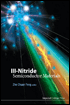
Written by renowned experts, this valuable resource covers the most important topics and achievements in recent years, discusses progress made by different groups, and suggests future directions.
 TABLE OF CONTENTS
 Haipeng Tang [1] and James B.Webb [2]
Although current commercial production of GaN based LEDs and LDs is dominated by the MOCVD technique, the emerging market demand for GaN electronics could see GaN-MBE technology becoming an important production tool for future generation RF and microwave electronic components. This chapter looks at the recent advances in molecular beam epitaxy of III-N materials for high-speed electronics applications. Two variations of the nitride MBE technique, ammonia-MBE and plasma-assisted MBE, are covered with reference to key growth challenges such as the growth of semi-insulating GaN. The advantages of the GaN MBE technology for producing high performance GaN/AlGaN HFETs such as the controlled carbon doping of semi-insulating GaN, high material purity and electron mobility, good uniformity and device scalability, and excellent small and large signal RF performance are reviewed.
Molecular Beam Epitaxy (MBE) has now reached a high level of sophistication in terms of ultra-high vacuum capability, material purity, in-situ monitoring and control. The technology of MBE has been developed over many decades and today the technique has been successfully applied to the growth of a broad range of materials, particularly group III-V semiconductor compounds. It is still a tool of choice for many researchers for developing new material systems due to its extensive "in-situ" monitoring capabilities. Many reviews are available describing the technique of MBE1 , 2 and thus this chapter will be limited to a discussion of the MBE technique as applied to group III-Nitride semiconductors for high electron mobility transistor(HEMT)...