Materials Degradation and its Control by Surface Engineering, 2nd Edition
The interaction between two or more independent causes of materials degradation results in a duplex mode of materials degradation. The materials degradation rate whether expressed in loss of material or loss of mechanical strength is often faster than the sum of each form of materials degradation acting separately. For this reason, duplex modes of materials degradation are of great practical importance. Synergism between unrelated forms of materials degradation are not immediately obvious and have in some instances been only recently recognized. For example, in minerals processing, the shiny or polished surfaces of tools processing mineral slurries delayed recognition of the fact that corrosion and wear acted synergistically to rapidly destroy the tools.
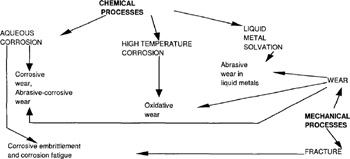
There are many forms of synergism between independent modes of materials degradation, the most significant of these are illustrated schematically in Figure 5.1.
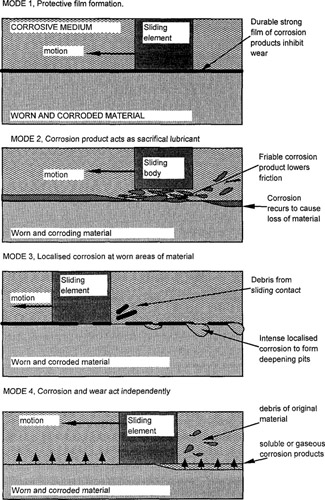
The primary source of destructive synergism is the interaction between chemically and mechanically driven materials degradation. Aqueous corrosion, high temperature corrosion and liquid metal solvation combine (separately) with wear and fracture to cause corrosive wear, corrosive-abrasive wear, oxidative wear, corrosion fatigue and embrittlement. There are numerous examples of these duplex modes of materials degradation to be found in minerals processing plant, petrochemical refineries, outdoor steel structures and other industrial plant. All the phenomena shown schematically in Figure 5.2 are discussed in this chapter.