Photonic Glasses
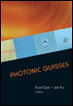
Introducing the fundamental mechanism of photonic glasses, this book puts emphasis on new developments in the structure, spectroscopy and physics of new glassy materials for photonics applications.
 TABLE OF CONTENTS
 Silica-based glass is one of the important optoelectronic and photonic materials. It exhibits extremely low optical loss over broad transmission band from the ultraviolet to the near infrared; it has high optical damage threshold; and it is compatible with the current fiber technology. So silica-based glass has very important applications as optical waveguides and other optoelectronic devices. [1] - [6]Generally speaking, there should be no second-order optical nonlinearity in glass because of its inversion symmetry. This has usually brought the glass material only to the passive usages like fibers in photonics, while the second-order optical nonlinearity is the property that absolutely required for active applications in photonics.
In 1986, however, Osterberg and Margulis discovered an efficient second harmonic generation (SHG) in silica-based optical fiber by irradiation with a laser light. Its second harmonic conversion efficiency was as high as 5%. [7] Later, in 1991, Myers et al. found that a permanent and large second-order optical nonlinearity could be generated in silica glass by thermal poling method. [1] A second-order nonlinear susceptibility ? (2) as large as 1 pm/V was induced in bulk silica glass. The large second-order optical nonlinearity induced in fibers and glasses is of great interest since it opens new frontiers in optical material research. Since then, a large number of investigati/pons have been done to search for novel glass materials and optimum poling conditions for the highest nonlinearity, and to make practical applications feasible. [8]
The second-order optical nonlinearity in...