Polymers in Electronics: Market Report
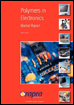
Identifying trends and future movements of the market, this report seeks to provide an overall picture of the varied use of polymers in the manufacture of electronic components.
 TABLE OF CONTENTS
 It should be borne in mind that all plastics experience thermal ageing, a process caused by exposure to heat over long periods. It effects are aggravated by external influences such as radiation or additional stress whether it be chemical, electrical or mechanical. It is possible to test samples of materials and obtain data which will assist, but not absolutely determine, the selection of appropriate polymers for specific applications. In case of electrical strength the guideline standard is the material's relative thermal index (RTI) value as referred to in UL 746B [1]. The Ti value or mechanical strength, using the criterion of a 50% reduction in tensile strength after 20,000 hours operation, is covered in IEC 60 216-1 [2]. The Ti temperature value for the material should not be exceeded by the sum of the ambient temperature and the rise in temperature when the component is in use.
ABS is claimed to be the engineering resin most used when measured in terms of sales volume. Mainly used in the automotive industry, its second largest user sector is the electronics sector where it is a popular choice, especially for the production of intricate parts. ABS has good dimensional stability at both high and low temperatures and ABS may be coated with metallic surfaces, for example nickel. Its UL 94 [3] flammability classification is from HB to V0. Many manufacturers, who offer different grades according to the end use, include BASF (Terluran), Dow (Magnum) and Polimeri...