4G Roadmap and Emerging Communication Technologies
After the introduction to 4G in the previous chapters, access techniques is the next natural topic to be discussed because the first and foremost challenge has always been to select a suitable access technique for defining and developing any mobile communications generation. At the moment we are struggling to find a solution to this challenge for 4G [1 6].
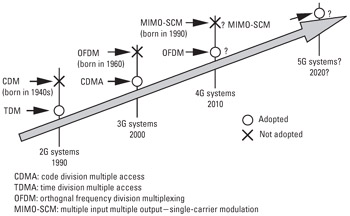
Figure 3.1 shows the history and evolution of access techniques over the generations of mobile communications systems. In the discussion about 2G systems in 1980s, there were two candidates for the radio access technique: the time division multiple access (TDMA) and code division multiple access (CDMA) schemes. The TDMA scheme was eventually adopted as the standard. In the discussion of 3G systems in 1990s, there were also two candidates: the CDMA scheme that was not adopted in the older systems and the orthogonal frequency division multiplexing (OFDM)-based multiple access scheme called band division multiple access (BDMA) [7]. CDMA was adopted as the standard. If history is repeated that is, if the access technique that was once not adopted can become a standard in a new generation system OFDM-based technique looks to be promising as a 4G standard.
The following list provides some of our justifications:
Multicarrier techniques can combat hostile frequency selective fading encountered in mobile communications. The robustness against frequency selective fading is very attractive especially for high-speed data transmission [8].
The OFDM scheme has been well matured...