Accuracy and Stability of Numerical Algorithms, Second Edition

Not a single student showed up for Newton's second lecture, and throughout almost every lecture for the next seventeen years ... Newton talked to an empty room.
- MICHAEL WHITE, Isaac Newton: The Last Sorcerer (1997)
[On Newton's method]
If we start with an approximation to a zero which is appreciably more accurate than the limiting accuracy which we have just described, a single iteration will usually spoil this very good approximation and produce one with an error which is typical of the limiting accuracy.
- J. H. WILKINSON, Rounding Errors in Algebraic Processes (1963)
Newton's method is a key tool in scientific computing for solving nonlinear equations and optimization problems. Our interest in this chapter is in Newton's method for solving algebraic systems of nonlinear equations.
Let F :
be continuously differentiable and denote by J its Jacobian matrix ( ? F i/ ? x j). Given a starting vector x 0, Newton's method for finding a solution of F( x) = 0 generates a sequence { x i} defined by
The attraction of the method stems from the fact that, under appropriate conditions, it converges rapidly to a solution from any starting vector x o sufficiently close to that solution. In particular, if the Jacobian is nonsingular at the solution then the rate of convergence is quadratic [333, 1983, Thm. 5.2.1].
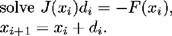
Computationally, Newton's method is implemented as
In practical computation rounding and other errors...