Applied Reliability-Centered Maintenance
Chapter 9: Measures

We don't see things as they are, we see things as we are.
-Anais Nin

Measurement

Global

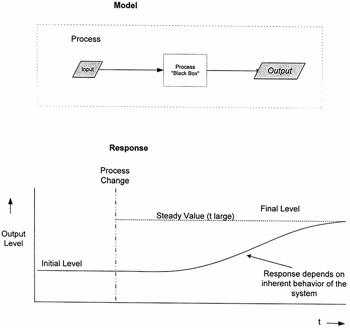
Accepting the challenge of an RCM/ARCM program is an example of a process shift. When a process shift occurs, what precisely happens? At the plant or company level, it doesn't mean that we instantaneously have a new process, with new results. Any major organizational change requires time, effort, and resource dedication to implement. But what if we could change a system or its inputs instantaneously? We check a control system response by feeding in a new signal. (Fig. 9-1) Treating a system in the same way, we should see a new response (with some dynamic delay). If we could model in this way, what would the response level be?

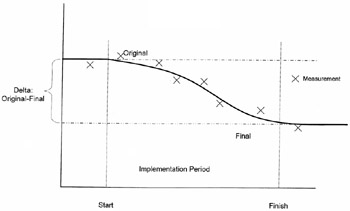
Theoretically, output would start to respond once the change occurred. When control system input takes a step change, the process output instantaneously has a new equilibrium value. It just takes time for the process to get to the new value. Taking the system to be "the maintenance process," the input as "maintenance selection," what are some suitable output measures? Based on theory and our projections, what do we expect to change? Our outputs are maintenance costs, unit production cost, and R. To see change, we must measure their response. Ideally, we achieve an appropriate level (Fig. 9-2).


Figure 9-1: Process Change

Figure 9-2: Maintenance Cost

We change a maintenance or operating plan to either increase production, reduce costs, or both. R is a byproduct it's...

UNLIMITED FREE
ACCESS
TO THE WORLD'S BEST IDEAS

SUBMIT
Already a GlobalSpec user? Log in.

This is embarrasing...

An error occurred while processing the form. Please try again in a few minutes.

Customize Your GlobalSpec Experience

Category: Oxidation Reduction Potential (ORP) Instruments
Finish!
Privacy Policy

This is embarrasing...

An error occurred while processing the form. Please try again in a few minutes.