Basic Water Treatment, Third Edition

This chapter gives an overview of membrane processes. It will define the various membrane processes, introduce some of the key concepts involved and discuss the reasons for their increasing use.
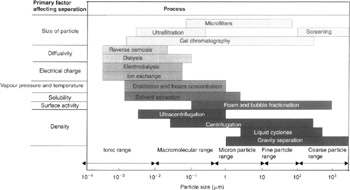
The term membrane process applies to processes that use membranes to remove either very small particles or molecules and ions from water. Figure 10.1 shows the range of particle sizes associated with membrane treatment and the membrane treatment processes used for different sizes of particles. [1] It should be noted, however, that there are no hard and fast definitions of the particle sizes treated by the different processes and different definitions to those given below are common. It is also common to specify the approximate molecular weight of the molecules retained by the coarser membranes as this better reflects their performance.
Reverse osmosis is the process that removes essentially all particles and dissolved chemicals from water. However, small dissolved undissociated molecules and dissolved gases do pass through the membranes. The mechanism of separation is a mix of physical straining and diffusion. Although it is arguably misleading, reverse osmosis is often considered to remove particles below 1 nm (0.001 ?m). Nanofiltration is reverse osmosis but refers to the use of leakier membranes that typically allow through a high proportion of monovalent ions and a small proportion of bivalent ions. With the wide range of membranes available reverse osmosis membranes can be optimized to remove particular sizes of dissolved molecules and...