Ceramics Materials: Processes, Properties and Applications
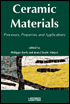
Primarily an introduction to ceramic materials, this authoritative reference examines both traditional and "technical" ceramics and their respective properties and applications.
Ceramics Materials: Processes, Properties and Applications
By Jean-Claude Niepce (eds)
List of Figures
Chapter 1: Ceramic Compounds Ceramic Materials
Figure 1.1: Main compounds in the diagram Al 2O 3?SiO 2?MgO []
Figure 1.2: Main crystallized varieties of silica
Figure 1.3: Illustration of the structure of quartz (on the right) and silica glass (on the left); this two-dimensional diagram must be imagined in three dimensions, the silicon atom (full circle) being at the center of a tetrahedron of four oxygen atoms (hollow circle), of which only three are represented here
Chapter 2: History of Ceramics
Figure 2.1: Anthropomorphic vase of the final Neolithic ( National Museum of History, Sofia)
Figure 2.2: Grog temper of a ceramic in Northern France petrographic microscopy on thin section ( C2RMF photo: A. Leclaire)
Figure 2.3: Painted vase of Mehrgarh (Indus-Pakistan valley), pre-Indus period ( C. Jarrige)
Figure 2.4: Tanagra statuette inv. 556 Louvre Museum Department of Greek, Etruscan and Roman Antiquities ( C2RMF photo: G. Koatz)
Figure 2.5: Attic crater inv. MNE938 Department of Greek, Etruscan and Roman Antiquities PAS 00 ( C2RMF photo: D. Vigears)
Figure 2.6: Bust of young man attributed to Della Robbia inv. OA1932 Department of sculptures Louvre Museum ( C2RMF photo: D. Bagault)
Figure 2.7: St Porchaire ewer inv. Ec83 National Museum of the Renaissance Ecouen ( C2RMF photo: D. Bagault)
Figure 2.8: Salt glazed stoneware vase. Martainvill ( O. Leconte)
Figure 2.9: White-blue ewer of Yuan era (1335) inv. MA 5657 Guimet Museum ( ...
Copyright ISTE Ltd. 2007 under license agreement with Books24x7