The Chemistry of Explosives, Second Edition

A propellant is an explosive material which undergoes rapid and predictable combustion (without detonation) resulting in a large volume of hot gas. This gas can be used to propel a projectile, i.e. a bullet or a missile, or in gas generators to drive a turbine, i.e. torpedoes.
In order to produce gas quickly a propellant, like a high explosive, must carry its own oxygen together with suitable quantities of fuel elements, i.e. carbon, hydrogen, etc. A homogeneous propellant (mono-propellant for liquid propellants) is where the fuel and oxidizer are in the same molecule, i.e. nitrocellulose, whereas a heterogeneous propellant (bipropellant for liquid propellants) has the fuel and oxidizer in separate compounds. Gun propellants are traditionally known to be homogeneous, whereas rocket propellants are heterogeneous.
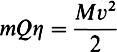
Gun propellants are designed to provide large quantities of gas which is used to propel projectiles at high kinetic energies. The velocity of the projectile is dependent on the rate at which the gas is produced, which in turn is dependent on the amount of chemical energy released, and the efficiency of the gun ? as shown in Equation 8.1.
Therefore,
Here, ? is the muzzle velocity of the projectile in ms ?1, m and M are the mass of the propellant and projectile in grams, respectively, and Q is the amount of chemical energy released by the combustion of the propellants in J g ?1.