4.7 Encoding with a Linear Code
Let C be an [ n, k, d]-linear code over the finite field F q. Each codeword of C can represent one piece of information, so C can represent q k distinct pieces of information. Once a basis { r 1 , , r k} is fixed for C, each codeword v, or, equivalently, each of the q k pieces of information, can be uniquely written as a linear combination,
where u 1 , ,u k ? F q.
Equivalently, we may set G to be the generator matrix of C whose ith row is the vector r i in the chosen basis. Given a vector u = ( u 1 , ,u k) ?  , it is clear that
is a codeword in C. Conversely, any v ? C can be written uniquely as v = u G, where u = ( u 1 , ,u k) ? . Hence, every word u ? can be encoded as v = u G.
The process of representing the elements u of as codewords v = u G in C is called encoding.
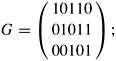
Example 4.7.1 Let C be the binary [5 , 3]-linear code with the generator matrix
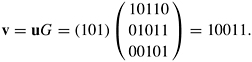
then the message u = 101 is encoded as
Note that the information rate...

 TABLE OF CONTENTS