Computational Materials Science of Polymers

Chapter IV: Glass Transition Temperature of Polymers

IV.1. Thermomechanical and other Methods of Evaluation of the Glass Transition Temperature of Polymers

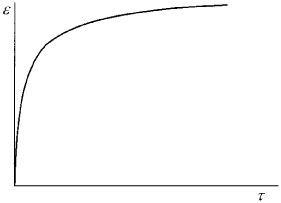
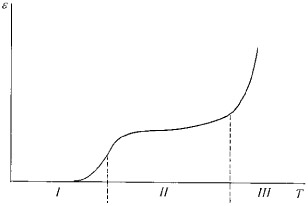
The thermomechanical method of studying polymers is one of the most widespread methods of experimental determination of glass transition temperature T g. This method has been developed by V.A. Kargin and T.I. Sogolova. The essence of the method is the following. A polymeric substance is subjected to a permanent or variable load. Therewith, its deformation at each temperature and selected time of the load effect is recorded. It is known that if a polymeric sample is subjected to a constant stress, creep develops in it. Graphically, this looks as depicted in Figure 17. To perform these experiments under comparable conditions, deformation must be measured during a strictly constant time of observation, which may be any but advisable so that reading of deformation would performed on the second, flattened part of the creep curve. Having performed such an experiment at different temperature, a temperature dependence of deformation may be plotted which, in the general case, will be the same as depicted in Figure 18.


Figure 17: Schematic representation of creep (dependence of deformation ? on time t at constant stress).

Figure 18: Schematic representation of the thermomechanical curve (dependence of deformation ? on temperature T) on which I is the glassy state of polymer, II is the rubbery state of polymer and III is the viscous flow state of polymer.

Before we proceed to consideration of features of the graphic in Figure...

UNLIMITED FREE
ACCESS
TO THE WORLD'S BEST IDEAS

SUBMIT
Already a GlobalSpec user? Log in.

This is embarrasing...

An error occurred while processing the form. Please try again in a few minutes.

Customize Your GlobalSpec Experience

Category: Thermomechanical Simulation Equipment
Finish!
Privacy Policy

This is embarrasing...

An error occurred while processing the form. Please try again in a few minutes.