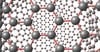
Attempts to introduce foreign materials into the empty central cavities of carbon nanotubes began soon after the appearance of Iijima s paper in 1991. This work was driven partly by curiosity the empty cavities represented ideal nano-test-tubes for the study of matter in confined spaces and partly by the idea of using nanotubes as templates for nanowires. There was also interest in the possibility of filling opened tubes with catalytic metals, to produce new size-selective catalysts. Multiwalled nanotubes were first successfully filled in 1993, using a technique that involved carrying out arc-evaporation in the usual way, but with an anode containing some of the material to be encapsulated. This method generally seems to favour the formation of filled nanoparticles rather than nanotubes, and is only applicable to materials that can survive the extreme conditions of the electric arc. A more generally applicable method, in which the tubes were opened and filled by chemical means, was introduced a short time later. This has now been applied to a wide range of materials, including biological molecules. Single-walled tubes were first opened and filled in 1997, and some fascinating work has been carried out on the effect of confinement in SWNTs on the structure of crystalline materials. There is also great interest in filling SWNTs with fullerenes. In the first part of this chapter the methods used to open and fill carbon nanotubes, and the new science and possible applications that are emerging from this work, will be summarized.
The second part...
Copyright Cambridge University Press 2009 under license agreement with Books24x7


 TABLE OF CONTENTS