Computer-Based Numerical & Statistical Techniques
Part 2 :

CHAPTER LIST

Chapter 4: Interpolation

PART OVERVIEW

  • Interpolation

    Finite Differences, Difference Tables, Errors in Polynomial Interpolation, Newton s Forward and Backward Formula, Gauss s Forward and Backward Formula, Stirling s, Bessel s, Everett s Formula, Lagrange s Interpolation, Newton s Divided Difference Formula, Hermite s Interpolation.

4.1 INTRODUCTION

According to Theile, Interpolation is the art of reading between the lines of the table .

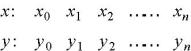
It also means insertion or filling up intermediate terms of the series. Suppose we are given the following values of y = f( x) for a set of values of x:


Thus the process of finding the value of y corresponding to any value of x = x i between x 0 and x n is called interpolation.

Hence interpolation is the technique of estimating the value of a function for any intermediate value of the independent variable, while the process of computing the value of the function outside the given range is called extrapolation.

4.2 ASSUMPTIONS FOR INTERPOLATION

  1. There are no sudden jumps or falls in the values during the period under consideration.

  2. The rise and fall in the values should be uniform. For example, if we are given data regarding deaths in various years in a particular town and some of the observations are for the years in which epidemic or war overtook the town, then interpolation methods are not applicable.

  3. When we apply calculus of finite differences, we assume that the given set of observations is capable of being...

UNLIMITED FREE
ACCESS
TO THE WORLD'S BEST IDEAS

SUBMIT
Already a GlobalSpec user? Log in.

This is embarrasing...

An error occurred while processing the form. Please try again in a few minutes.

Customize Your GlobalSpec Experience

Category: Color Meters and Appearance Instruments
Finish!
Privacy Policy

This is embarrasing...

An error occurred while processing the form. Please try again in a few minutes.