Design Patterns for Flexible Manufacturing

Chapter 9: Splitting and Merging Batches

Overview

One situation seen in all types of production is the splitting and merging of batches in a work center. This is common in many industries, such as in mixing of batches in brewing and splitting of batches in biotech industries.

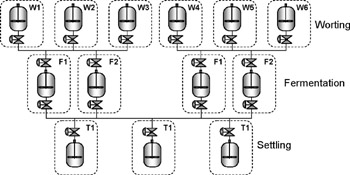
In brewing, there are usually several batches of wort that are combined into a fermentation tank. Then, the fermented beer from several tanks is combined into a settling and aging tank, as shown in Figure 9-1. Because of the variability of raw ingredients and fermentation time, it is impossible to predetermine a single recipe for all possible paths. Usually there are multiple wort batches per fermentation batch, and multiple fermentation batches for each settling batch. Because of material additions at each stage of product, each batch has a separate material genealogy.


Figure 9-1: Typical batch-merging situation.

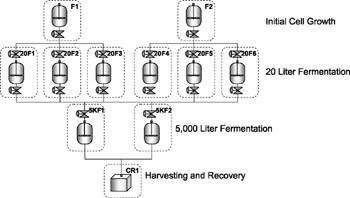
An example of batch splitting is in biotechnology fermentation. An initial cell culture is grown in a culture, as shown in Figure 9-2. Once it reaches a predetermined size, it is split into multiple parts and each part is separately fermented in small (e.g., 20 liters) vessels. Once grown, the batch may then be split several times to reside in multiple small vessels. When a predetermined size is reached, the material is transferred from a small vessel to a large (e.g., 5,000 liters) vessel for final growth. Once large vessel growth is complete, the material from the vessel is passed through harvesting and recovery of the active ingredient.


Figure 9-2: Typical batch-splitting situation.

UNLIMITED FREE
ACCESS
TO THE WORLD'S BEST IDEAS

SUBMIT
Already a GlobalSpec user? Log in.

This is embarrasing...

An error occurred while processing the form. Please try again in a few minutes.

Customize Your GlobalSpec Experience

Category: Laboratory Reactors
Finish!
Privacy Policy

This is embarrasing...

An error occurred while processing the form. Please try again in a few minutes.