Digital Video Broadcasting: Technology, Standards and Regulations

An overview of the technical, political, and market issues relating to digital video broadcast and digital television.
 TABLE OF CONTENTS
 The fact that the European Union (EU) has consisted of 15 culturally different member states since 1995 can only hint at the difficulties involved in developing a pan-European policy on a subject as difficult as television. These difficulties do not arise as a consequence of the fact that the television set has always been a highly technologically driven apparatus. The difficulties stem from the fact that when speaking of television, one also speaks of culture. In the EU context, this implies different cultures in as many as 15 Member States.
The European development of DTV started outside the EU competence under the so-called EUREKA flag. EUREKA was a pan-European research cooperation that resulted in, among other things, funded research projects on HDTV involving HD-MAC ( high-definition multiplexed analog component). Later on, this technological development was supported by the EU through the incorporation of the used technologies into a legally relevant text: the HD-MAC Directive. However, the obligation for European satellite operators to apply D2-MAC never attracted much support in the (audiovisual) industry and satellite operator business.
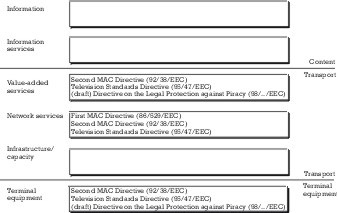
Before going into too much detail, however, it is necessary to discuss the general EU policy and the legal framework in which the development of advanced television came into being (see Section 6.2). Figure 6.1 presents the framework applied in the European advanced television s context (with reference to Section 2.3.1 on the layer model).