Electrical Engineer's Portable Handbook, Second Edition
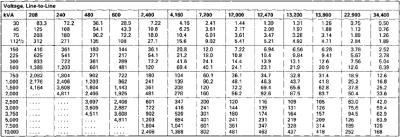
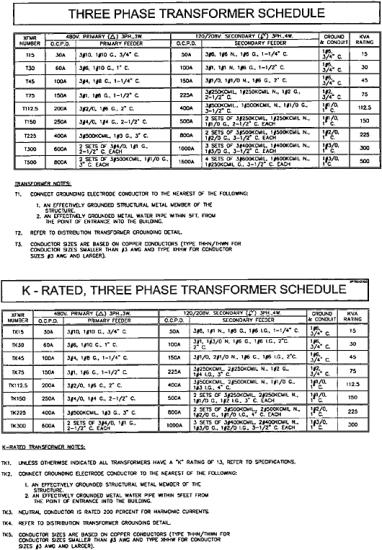
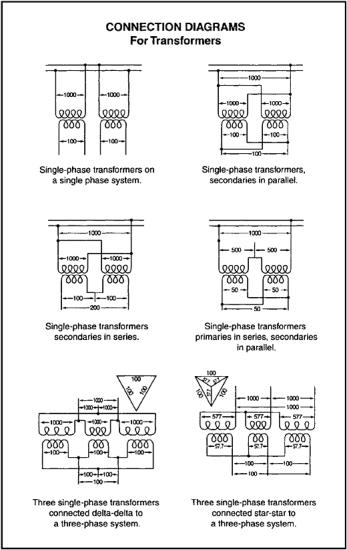
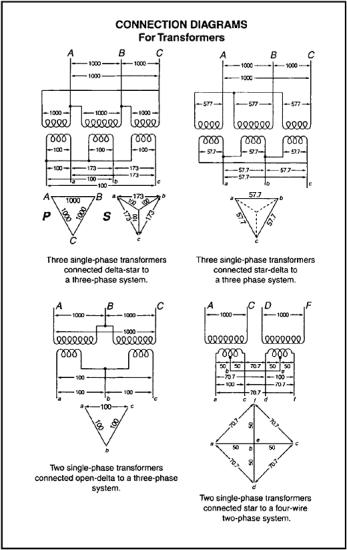
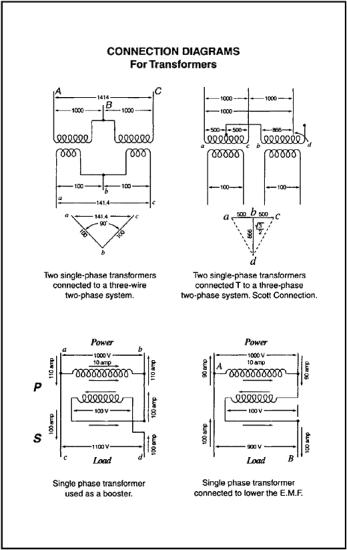
Transformers are a critical part of electrical distribution systems because they are most often used to change voltage levels. This affects voltage, current (both load and fault current levels), and system capacity. They can also be used to isolate, suppress harmonics, derive neutrals through a zig-zag grounding arrangement, and reregulate voltage. Their electrical characteristics are as follows (see Tables 3.31-3.34 and Figure 3.31).
| |
| |
| |
| |
| |
| |
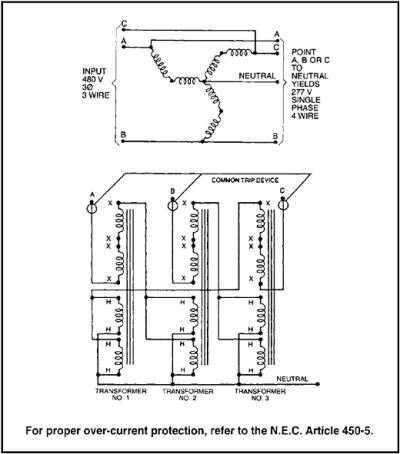
Three single-phase transformers can be connected in an autotransformer arrangement for developing a neutral from a three-phase, threewire supply (phase-shifting). For proper overcurrent protection, refer to NEC Article 450.4. Figure 3.32 shows the one line and wiring diagrams for this arrangement.
Table 3.35 shows the nameplate kVA for each transformer, number of transformers required, three-phase kVA rating, and maximum continuous amp load per phase (@ 277 V) for a primary input of 480 V, threephase, three-wire, to a secondary output of 480Y/277 V, three-phase, four-wire.
| |
| |
| Connection diagram (using 3 pieces of 1 phase. 60 hertz transformers connected zig-zag auto for developing a neutral (4th wire) from a 3 phase 3 wire supply, Applicable for the above connection... |