Electromagnetic Field Measurements in the Near Field

The precision of EMF measurements in the near-field, near numerous primary and secondary sources, where there are usually three spatial field components, i.e., quasi-spherical polarization, includes the necessity of simultaneous measurement of all three components. We should explain at the very beginning that spherical field polarization, in light of physics, does not exist; and that the quasi-spherical or the quasi-spherical polarization is understood here as a circular or an elliptical polarization whose plane of polarization makes arbitrary rotations in space. This may occur for instance, as a result of multi-path propagation and interference. These measurements may be achieved using a meter equipped with a probe and single dipole antenna, whose directional pattern is of sinusoidal shape, by way of individual spatial component strength measurements and then by finding the total field using simple calculations. However, because of the difficulties in making large numbers of calculations, this procedure may lead to gross errors and mistakes.
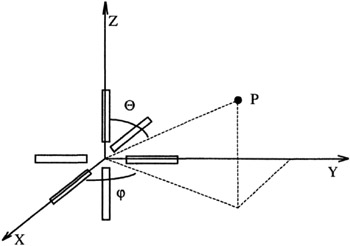
By intuition it may be surmised that design of a probe which is sensitive to the three spatial components of the field should include an antenna system containing three mutually perpendicular dipole antennas as shown in Figure 4.11.
The emf induced in separate dipoles by an arbitrarily located E-field vector may be calculated using Formula (4.1). For i-th dipole it is:
If, in formula (4.37) we substitute i for x, y and z we solve for the electromotive forces induced...