Fluid-Structure Interaction
In this text, 9 case studies examine mathematical and numerical models for studying the interaction of a fluid and a structure in a mechanical system.
 TABLE OF CONTENTS
 Here fully coupled means that the fluid and the structural response are integrated in time as a closed system at the same time level by implicit methods; this is in contrast to the so called staggered algorithms whereby the fluid and the structure are integrated in time separately and the information transfer is done after every update time step. However since time steps as determined by [10] are very small, explicit methods evaluate at the same time level, as specifically designed staggered algorithms as shown in works of C. Farhat et al., [FAR 95], [FAR 98b], [FAR 98c]. There exist several different methods of coupling the iterations between the fluid and the structure.
The coupling algorithm can be performed in a staggered way, with various degrees of subcycling of the fluid solver. These methods are often explicit and have stability constraints that can become inconsistent.
At time t n the state of the fluid, structure and mesh is known. In order to advance the system to the next time level since the explicit fluid solver requires small time steps to maintain stability, whereas the structure solver often allows for larger time steps since its characteristic time scale is often larger, the fluid is subcycled according to the structure.
Standard staggered algorithm (Figure 2)
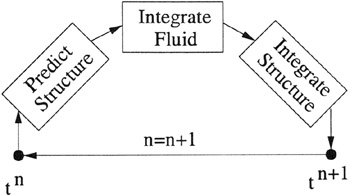
Predict the state of the structure at the end of the current time step (