Gigabit Ethernet for Metro Area Networks
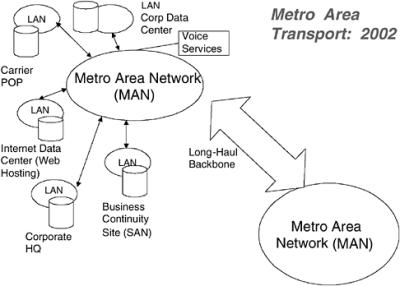
Metropolitan networks serve largely as a middleman for other networks, as illustrated in Figure 2-5.
However, this involves considerably more than providing a simple high-speed connectivity service. In fact, the value-added services and features serve to differentiate one metropolitan network provider from another. A service-rich platform should include the following features:
Leverage of the existing infrastructure Service providers must offer advanced capabilities to support the services delivered over the metro network. For example, content and application hosting requires intelligent caching, load distribution ( server load balancing [SLB]), and secure service partitioning without loss of performance. At the same time, access network providers require dynamic self-provisioning. Adding a new customer should not require revising the physical plant of the network. This network feature will reduce operating costs and maintain customer satisfaction. The metro infrastructure must provide security to protect customer data, reliability to route around failures, and scalability to maintain the return on investment (ROI) throughout hectic subscriber acquisition and growth cycles.
Bandwidth control and service provisioning Service providers that make optimal use of their resources are more profitable. Bandwidth control and rapid service provisioning are among the important functions that network equipment must now perform, providing one of many opportunities for charging on the basis of various service levels. Managing data flows, muxing lower-speed data streams, and limiting network accessibility are examples of functions that manage the consumption of network bandwidth.