GPRS for Mobile Internet

This book helps you understand how the GPRS system is used as a major technology building block for the emerging mobile Internet; the book
also provides you with detailed coverage of a wide range of important topics.
 TABLE OF CONTENTS
 During an uplink transfer, the network allocates uplink resources to the mobile either dynamically with the use of the USF (dynamic allocation or extended dynamic allocation) or at fixed occurrences (fixed allocation). In the case of an open-ended TBF, however, the network does not know exactly when the TBF will end.
In order to avoid the loss of uplink resources allocated by the network (because the mobile has finished its uplink transfer), a countdown procedure has been introduced.
This procedure allows the network to anticipate the end of the TBF and thus to avoid wasting uplink resources. The procedure involves triggering a countdown when the mobile starts sending its last 16 blocks. It uses the CV of the uplink data block header. The procedure is illustrated in Figure 5.27.
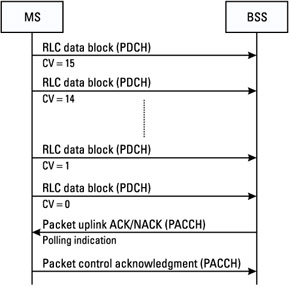
When the mobile starts sending its last 16 blocks, it starts decrementing the CV at each transmission. The last block of the TBF is sent with CV = 0.
When the network receives the last uplink RLC data block and if all the blocks have been correctly received, it sends a PACKET UPLINK ACK/NACK message with the FINAL_ACK_INDICATOR bit set to 1. The network polls the mobile in order to be sure that the mobile has received the PACKET UPLINK ACK/NACK message and to confirm the release of the TBF.
At the reception of the PACKET UPLINK ACK/NACK message, the mobile transmits a PACKET CONTROL ACKNOWLEDGMENT...