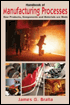
Handbook of Manufacturing Processes: How Products, Components and Materials Are Made
Section II: How Products, Components and Materials Are Made

Chapter List

Chapter 15: A
Chapter 16: B
Chapter 17: C
Chapter 18: D
Chapter 19: E
Chapter 20: F
Chapter 21: G
Chapter 22: H
Chapter 23: I
Chapter 24: J
Chapter 25: K
Chapter 26: L
Chapter 27: M
Chapter 28: N
Chapter 29: O
Chapter 30: P
Chapter 31: Q
Chapter 32: R
Chapter 33: S
Chapter 34: T
Chapter 35: U
Chapter 36: V
Chapter 37: W
Chapter 38: X
Chapter 39: Y
Chapter 40: Z

Abrasives Aluminum Foil

Abrasives

Are materials used to polish or machine metals, wood, stone, glass, and other materials by the cutting action of the small grains of the material. (Abrasive machining is described and illustrated in 3C). There are two kinds of abrasives, natural and man-made. Natural abrasives include aluminum oxide ("corundum"), emery (impure aluminum oxide), diamond, sand, crushed garnet, quartz, tripoli, talc, and pumice. These materials are mined, crushed, classified by size and shape, and usually bonded together in a grinding wheel, stone or block, or bonded to paper or cloth. Man-made abrasives are silicon carbide (SiC) "Carborundum", aluminum oxide (Al 2O 3) "Alumina", boron nitride (BN), and boron carbide (B 4C) made by various chemical processes.

Silicon Carbide

Is made from pure sand, coke, sawdust, and salt. The mixture of these ingredients is placed in a long, trough-like furnace and heated by an electric current from graphite electrodes. Temperatures up to 4400 F (2400 C) cause a complex chemical reaction that yields SiC and carbon monoxide. Crushing of...

UNLIMITED FREE
ACCESS
TO THE WORLD'S BEST IDEAS

SUBMIT
Already a GlobalSpec user? Log in.

This is embarrasing...

An error occurred while processing the form. Please try again in a few minutes.

Customize Your GlobalSpec Experience

Category: Garnet, Emery, and Mineral Abrasives
Finish!
Privacy Policy

This is embarrasing...

An error occurred while processing the form. Please try again in a few minutes.