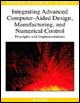
Integrating Advanced Computer-Aided Design, Manufacturing, and Numerical Control: Principles and Implementations
Integrated feature technology promotes a closer connection between design and manufacturing through features. When machining features are determined, they may or may not be readily useable for a process planning system. In a feature-based design system, features in a design model are of design type of features. Further conversion is also needed to arrive at machining features. This chapter starts with a discussion on the issues of interfacing and integration. This is followed by some of the methodologies that can bring feature technologies one step closer to manufacturing processes.
Representing a machining feature in terms of its machining volume that can directly corresponds to a specific type of machining operation (e.g. finishing, semi-finishing, and roughing operations) is one of the methods introduced in this chapter. In order to achieve this, a number of machining operations is to be decided. For this, tolerances, surface, finish, and other design information are to be considered. The fuzzy nature of these data and the concerning knowledge means that an appropriate treatment of such information is also needed. A direct way of linking a feature-based design model with machining operations is to map the design features to machining features and perhaps further to the cutting tools that may be used to produce the features.
There exist some confusions between integrated and interfaced feature technologies. Careful examination shows that many systems are mainly trying to interface various separated activities at the design, manufacturing, and planning phases. One difference between interfacing and integration...