Internal Flow: Concepts and Applications

Providing students and practicing engineers with a range of analytical tools, this book describes the analysis and behavior of internal flows encountered in propulsion systems, fluid machinery, and ducts.
 TABLE OF CONTENTS
 The relations developed for one-dimensional flow describe steady-state operation at given conditions, but for actual devices (as well as for some computational procedures) it is often necessary to address how one would attain the condition starting from an initial condition of no flow. Definition of the path to the desired condition brings out a critical problem associated with supersonic devices (Kerrebrock, 1992; Heiser and Pratt, 1994). To see this consider the supersonic wind tunnel in Figure 10.8(a) which has a converging diverging nozzle, a constant area test section, a converging diverging diffuser with a throat larger than the nozzle throat, and a downstream exhauster (often a centrifugal or axial compressor). The tunnel is fed by a reservoir at a specified upstream pressure and stagnation temperature, p t and T t, and the exhauster can be thought of as creating a specified static pressure at the exit.
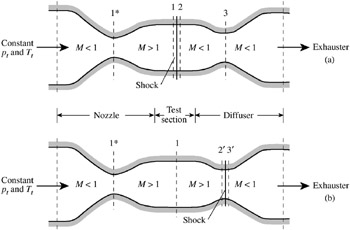
At levels of exit static pressure close to the inlet stagnation pressure the flow throughout the tunnel is subsonic. As described in Section 2.7, lowering the static pressure causes the flow to become sonic at the nozzle throat, with a shock in the divergent part of the nozzle. In this mode of operation, the throat passes the maximum mass flow for the upstream p t