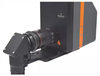
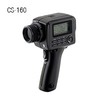
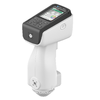
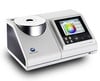
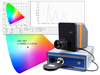
Quantitative analysis in color imaging requires measurements of all the relevant characteristics of the scene, the imaging system, and the display devices and media. The major concepts underlying these measurements, such as radiometry, photometry, colorimetry, and scene physics, have been covered in the previous chapters in the book. In this chapter, we will briefly describe how various measurement instruments work and study how color measurements are performed. Various national and international standards have been defined (such as in [39, 444]) and it is important to understand them if accurate, standard measurements are required.
There are three major types of color measurement in color imaging: spectral measurement, colorimetric measurement, and density measurement. In addition to these three types, some applications also require the measurements of spectral distribution as a function of geometrical variables, such as the incident angles and the reflection angles. For example, measurements of the BSRDF of surface materials are often performed for textile, printing, or computer animation applications. Instruments that can make this type of measurement are called gonioreflectometers.
15.1 Spectral Measurements
The first step in many color imaging applications is to calibrate the devices that will be used in the application, so that quantitative physical relations can be established between the scenes, the sensors, and the displays. The most detailed description of a color stimulus is its absolute spectral power distribution. This is usually measured as spectral radiance or spectral irradiance by an instrument called a spectroradiometer. For many applications, only relative spectral power distributions...
Copyright Cambridge University Press 2005 under license agreement with Books24x7


 TABLE OF CONTENTS