Land Development Handbook: Planning, Engineering, and Surveying, Third Edition

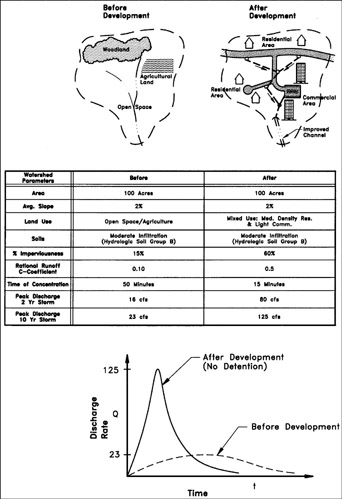
Transforming land from vacant or rural to residential/ commercial use inevitably results in a decrease in pervious surface and an increase in impervious surface. This transformation in the surface results in a change in the hydrologic and hydraulic characteristics of the watershed. The development of watersheds has historically resulted in an increase in the postdevelopment flow rates, the runoff volumes, and frequency of flooding as well as the degradation of surface water quality. In order to convey the increased runoff, systems consisting of curb and gutter, storm sewer, paved or earthen ditches, and channels are typically developed to safely convey the runoff through the developed basin. These man-made conveyance systems directly increase flow velocity, which decreases the basin time of concentration, resulting in higher peak flow rates. This increase can be fairly dramatic when you consider that in a typical moderately developed watershed, the increase in peak discharge could be from two to five times higher than predeveloped conditions. Perhaps more important, the volume of runoff can be increased by as much as 50 percent and the time of concentration may be decreased by an even greater percentage (see Figure 22.1).
Along with the increase in water quantity, urbanization results in an increase in non-point-source (NPS) pollutants. Trace metals from galvanized downspouts, flashing and roofing materials, and pipes are washed into natural channels. Other pollutants such as tire particulate, hydrocarbon products from pavement and fuels, and mechanical...