Lasers and Current Optical Techniques in Biology: Comprehensive Series in Photochemistry and Photobiology, Volume 4

Optoacoustic imaging is an imaging modality based on pressure waves generated in light-absorbing objects by pulsed lasers. An array of acoustic detectors record the time-resolved arrival of pressure waves from a region of interest. Backprojection of these time-resolved recordings yields a reconstruction of the original energy deposition. Such imaging is suitable for imaging blood vessels, hemorrhages, and pigmented lesions such as melanoma.
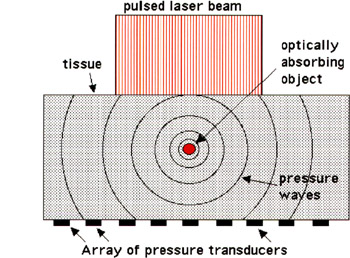
Optoacoustic imaging or photoacoustic imagingis an imaging modality that uses pressure waves induced by a pulsed laser (Figure 1). A pulsed laser source illuminates a tissue and generates heat in an absorbing object within a tissue. The thermoelastic expansion of the heated object creates a pressure wave that propagates to the tissue surface where an array of detectors records the time-resolved arrival of pressure. A computer algorithm backprojects these time-resolved recordings into the tissue to map the source of the pressure waves, which is a map of the distribution of heat deposition.
Optoacoustic imaging is a special case of thermoacoustic imaging. In general, the pulsed energy source of thermoacoustic imaging can be a pulsed laser, a pulse of radiofrequency(RF) or microwave frequency electromagnetic energy, or any energy source that heats tissue. The principles of such imaging are the same regardless of the energy source. With pulsed RF or microwave energy, the heating of...