4.4 User Equipment Behavior
A fundamental design principle of LTE as well as its predecessors has been to allow the network to control UEs in connected mode that is, UEs that have a radio resource control connection to the network (often casually referred to as "active" mode UEs). This design principle has been useful for protocol design and, most importantly, for radio resource management purposes because the network is in the position of making network-wide near-optimal decisions, including intra-LTE and inter-RAT handovers, load balancing, and others.
In contrast, when the UE is not connected ("idle"), it has to act (much more) autonomously, although it is possible for the network to influence this behavior, as we shall see in this section. To this end, some issues of the UE behavior need to be standardized, which indeed has some RRM-related aspects.
The UE procedures in idle mode (including public land mobile network [PLMN]) and RAT selection, initial cell selection and cell reselection, cell reservations and access restrictions, and the receiving of broadcast information and paging) are specified by 3GPP TS 36.304 [15]. A schematic view of the UE behavior focusing on PLMN, RAT, and cell (re-)selection is depicted by Figure 4.19.
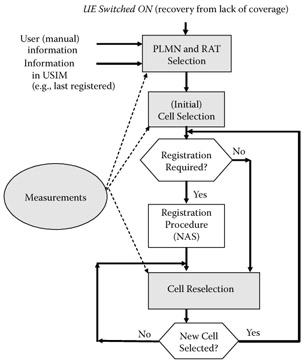 Figure 4.19: A schematic view of the UE behavior in LIE.
 During the standardization process, it was recognized that the identification of idle mobility (basically, cell reselection) drivers for scenarios in which the UE moves within the same carrier frequency (intrafrequency mobility) as well as when it can choose between different frequency layers...


 TABLE OF CONTENTS