I suspect a small percentage of machinists are completely sure of themselves when it comes to setting up and using a rotary table. You'll likely see a wide variety of bizarre methods used by machinists to set up jobs on a rotary table, many of which don't work. Like most things, it is not difficult once you understand it.
To precisely locate a circular part or feature on a rotary table, there are two things you must do.
The first and most important thing you must do is position the part over the true axis of the rotary table. You do that by spinning the rotary table and carefully bumping in the work-piece as you watch the indicator readings. (See Fig. 10-1) When the needle stops deflecting or reads "zero" the axis of the workpiece is directly over the axis of the rotary table. Your indicator does not have to be mounted in the machine spindle to accomplish this, but it can be.
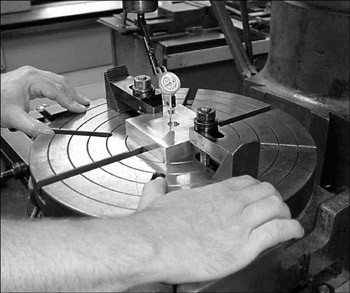 Figure 10-1: A part is lined up in the rotary table by spinning the table and bumping in the part until the indicator reads "zero"
 The second thing you must do is position the spindle of the milling machine directly over the axis of the workpiece. (See Fig. 10-2) You do that by spinning the indicator around the workpiece and adjusting the X and Y tables of your milling machine until the indicator reading doesn't change or reads zero. The indicator must be mounted in the spindle...
Copyright James A. Harvey 2004 under license agreement with Books24x7


 TABLE OF CONTENTS