4.1 A Uniform Ocean over an Elastic Seabed
In the previous two chapters we have discussed wave propagation in acoustic wave guides with a completely reflecting bottom and a pressure-release surface. In this section we will extend our discussion to the case of a time-harmonic point source in a water column with an interactive elastic seabed. Our approach follows that given in our papers [185], [186], [203].
We assume a time-harmonic, point source is situated in a homogeneous, shallow ocean of uniform depth h, which lies over an elastic seabed of finite depth b. Here the water column occupies the region
and the seabed occupies
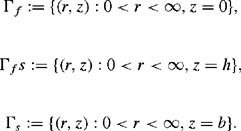
The boundaries of these regions, shown in Figure 4.1, are given by T f,T s and T fs:
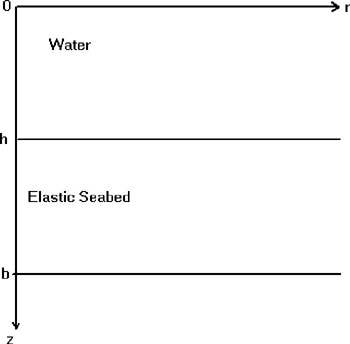 Figure 4.1
 Imbedded in the water column is a hard, smooth scatterer, which occupies the region D. On the ocean-seabed interface, both the reflection and transmission of acoustic energy occurs; namely, a portion of the energy leaves the ocean and enters the seabed. Another way of describing this situation is to note that the total field consists of direct radiation, partial reflection off the sea floor, and scattered radiation off the object.
For convenience we write x:=. (x, y), the pressure field as p(x, z), and the vertical displacement as u zo. Similar notation will be used for future unknown variables. We recall from Chapter 1 that these physical entities are related to each other by
where ?


 TABLE OF CONTENTS