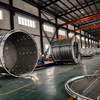
Materials Selection and Applications in Mechanical Engineering

Heat exchangers are vital equipment to remove excess heat from unwanted regions. The thermal energy removed may be vented out in air to the ambient or used to produce steam for further use or to generate electric power. Air conditioners use circulation of cooling fluids such as freon to remove heat from the hot ambient and cool the air to required lower temperature levels. The heat exchangers need efficient pumps to pump the fluids around. Materials used in heat exchangers should have primarily good thermal conductivity, but many other features such as corrosion resistance are needed too. These are discussed in this chapter in conjunction with two representative heat exchangers.
Heat exchangers (HEs) play a vital role in the chemical and processing industry. Plant engineers are, hence, constantly striving to obtain efficient and long lasting heat exchangers at reasonable cost for operation within the plant. The system can be a simple one in which water is used to remove the heat from a heat source. In most instances, in the chemical process industry, strong corrosion-causing chemicals are processed or handled; this requires vastly improved and specialized HE systems.
In the current example chosen for analysis, water is used as the heat exchanger fluid to remove the heat from hot, corrosive sulfuric acid. Major components in the tube and shell heat exchanger used are shown in Figure 30.1 . The major components are: the tube bundle, the shell in...