In this chapter we shall study the basic qualitative properties of the Euler and Navier-Stokes equations of compressible flow. We start with the Euler equations as a nonlinear hyperbolic system. Then the existence of smooth solutions and the typical phenomenon of loss of smoothness and lifespan of smooth solutions will be discussed. This is followed by an introduction to the theory of weak solutions with such concepts as shock and rarefaction waves, Rankine-Hugoniot conditions and entropy admissible solutions. In particular, existence results for one, two and m scalar conservation laws are given, and the Riemann problem in one space dimension is studied.
In the second part of this chapter a short overview of existence theory for the Navier-Stokes equations of compressible flow is presented. No detailed arguments are given for the Euler and Navier-Stokes equations and we refer the reader in this respect to the recent monograph (Novotn and Stra kraba, 2003).
2.1 Hyperbolic systems and the Euler equations
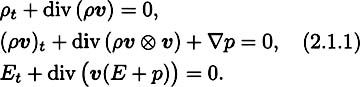
The Euler equations of (adiabatic) compressible fluid flow written in conservation form are as follows (see (1.2.107) (1.2.109)):
Here
is the total energy, ?( x,t) the density, v the velocity and e is the internal energy, which is to be specified by an appropriate constitutive equation, e.g.
obtained from thermodynamical laws (cf. Section 1.2.19).
The nonlinear system (2.1.1) can be written in the form
We assume that  are continuously differentiable functions and
  is an open set. We consider (2.1.4) in a space-time cylinder Q T
Copyright Oxford University Press 2003 under license agreement with Books24x7

 TABLE OF CONTENTS