Mathematical Modeling in Continuum Mechanics, Second Edition

The aim of this chapter is twofold. On the one hand, we introduce various kinematical quantities that will be useful in what follows especially in Section 5.3. On the other hand, we introduce and address an issue of a totally different nature, more physical and very important: the constitutive laws.
The constitutive laws in mechanics are usually laws that relate the stress tensor to the kinematical quantities; these laws depend on the physics of the material under consideration, contrary to the equations and laws previously written that are valid for all materials. These laws take into account, for instance, the differences of behavior between liquids and solids, or between rubber, wood, steel, and so forth.
We present, without pretending to be exhaustive, a list containing a variety of constitutive laws. These laws are different for solids and fluids; some materials have memory, others do not; some materials have different behaviors depending on certain parameters, whereas others have the same behavior for all regimes, and so forth. The study of the mechanical behavior of materials is called rheology; we also briefly describe some fundamental principles that rheological laws are required to satisfy.
In Chapter 1, we introduced the following deformation map:
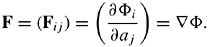
We also defined the gradient of ? (for fixed t) as follows:
In this section, we are going to make precise the role played by F = ? ? in the study of the local distortion of distances and...