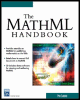
The MathML Handbook

Chapter 9: Authoring and Editing MathML

This chapter reviews some of the leading software tools available for authoring and editing MathML. The tools discussed include equation editors, like MathType and WebEQ, as well as full-featured document processing applications like Mathematica, Publicon, and Scientific Word.

9.1 Introduction

Most technical documents displayed on the Web currently are produced using one of two methods. The first method is to use a word-processing application like Microsoft Word for the text and to insert equations using the built-in Equation Editor, or its professional version, MathType. The Word document can then be converted into HTML using Word's As ? HTML feature, which converts all the equations into images. Users who have MathType, the professional version of Equation Editor, also have the option of using its MathPage feature to do the HTML conversion. This gives better results than Word's built-in HTML conversion, especially in the matter of integrating equations with the surrounding text. Alternatively, the Word document can be converted to PDF using Adobe Acrobat Distiller.

The second method, which is popular in the mathematical research community, is to use a TeX-based macro package such as LaTeX to author documents, freely mixing text and equations as desired. TeX offers a high degree of control over the final output and allows authors to produce publication-quality typesetting of mathematics. The finished document can then be converted to HTML using programs like LaTeX2HTML or TeX4ht, which convert all equations...

UNLIMITED FREE
ACCESS
TO THE WORLD'S BEST IDEAS

SUBMIT
Already a GlobalSpec user? Log in.

This is embarrasing...

An error occurred while processing the form. Please try again in a few minutes.

Customize Your GlobalSpec Experience

Category: Authoring and Publishing Software
Finish!
Privacy Policy

This is embarrasing...

An error occurred while processing the form. Please try again in a few minutes.