Microfluidics for Biotechnology

In the preceding section, we have investigated the kinetics of biochemical reactions. However, in reality they can seldom be considered alone without taking into account other physical phenomena like diffusion or transport. Indeed, the reactants are usually injected into the microchamber in which they later diffuse and react. Thus, it is important to consider the global problem of advection-diffusion, coupled with the biochemical reaction itself. We will consider next the kinetics of these coupled problems.
The reaction itself may be performed in two different ways: first, in the whole volume of the reaction chamber; second, on a functionalized surface located on the wall of the reaction chamber. The first type is called a homogeneous reaction; the second is called a heterogeneous reaction.
Thus, we will consider successively the reactions kinetics coupled with advection-diffusion phenomena for homogeneous or heterogeneous situations.
Let us consider a second-order reaction of the type
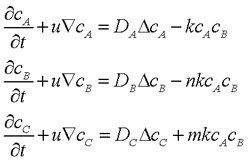
occurring in a fluid volume where the reactants A and B are transported by a flow of velocity u. If we recall the advection-diffusion equation (Chapter 4), and notice that there is now a sink-source term for concentration, the governing equations are [11]
| (5.52) | |
where D A, D B, and D c are the diffusion coefficients of species A, B, and C, and k is the reaction rate. In (5.52), we have adopted the concentration notations c A =