Microwave Transmission Networks: Planning, Design, and Deployment
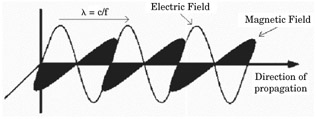
Radio waves and microwaves are forms of electromagnetic energy we can collectively describe with the term radio frequency or RF. RF emissions and associated phenomena can be discussed in terms of energy, radiation, or fields. We can define radiation as the propagation of energy through space in the form of waves or particles. Electromagnetic radiation can best be described as waves of electric and magnetic energy moving together (i.e., radiating) through space as illustrated in Fig. 2.1. These waves are generated by the movement of electrical charges such as in a conductive metal object or antenna. For example, the alternating movement of charge (i.e., the current) in an antenna used by a radio or television broadcast station or in a cellular base station antenna generates electromagnetic waves. These waves that radiate away from the "transmit" antenna and are then intercepted by a "receive" antenna such as a rooftop TV antenna, car radio antenna, or an antenna integrated into a hand-held device such as a cellular phone.
The term electromagnetic field is used to indicate the presence of electromagnetic energy at a given location. The RF field can be described in terms of the electric and/or magnetic field strength at that location. Like any wave-related phenomenon, electromagnetic energy can be characterized by a wavelength and a frequency. The wave-length ( ?) is the distance covered by one complete electromagnetic wave cycle, while the frequency is...