Mobile Agents for Telecommunication Applications

5. Simulations

5. Simulations

The audio mixing AA has been simulated with the help of an AN module that we developed for the NS simulator [NS 00]. This module implements a simplified AN architecture consisting of a NodeOS, an EE, and some resource managers. The simulated EE executives capsules written in TCL language.

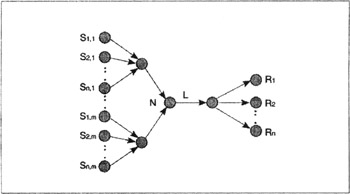
The topology for the simulations is shown in Figure 4. It consists of n sessions of m sources and one receiver each. The sessions traverse a bottleneck (link L), so that the capsules in active node N must decide to mix or to proceed intact to the receiver node, according to the prices of link or memory resources available from the resource managers.


Figure 4: Topology used in the simulations

The price function used is based on the one in [TSC 97]:

This function is a practical implementation of a convex increasing function that would go to infinity as the load approaches 100%. It forces the price to rise sharply as we approach high loads, which discourages applications from using a resource when its load is too high. This gives the applications a clear indication of the "dangerous zone" to avoid, while at the same time encouraging a relatively high utilization.

In the case of the memory manager, the load is given by the ratio between the average number of memory units occupied, and the total number of memory units available to user capsules (which is of course assumed to be much smaller than the actual amount...

UNLIMITED FREE
ACCESS
TO THE WORLD'S BEST IDEAS

SUBMIT
Already a GlobalSpec user? Log in.

This is embarrasing...

An error occurred while processing the form. Please try again in a few minutes.

Customize Your GlobalSpec Experience

Category: GPS Chips and Modules
Finish!
Privacy Policy

This is embarrasing...

An error occurred while processing the form. Please try again in a few minutes.