Numerical Linear Algebra

Lecture 39: Biorthogonalization Methods

Not all Krylov subspace iterations for nonsymmetric systems involve recurrences of growing length and growing cost. Methods based on three-term recurrences have also been devised, and they are the most powerful nonsymmetric iterations available today. The price to be paid, at least for some of the iterations in this category, is that one must work with two Krylov subspaces rather than one, generated by multiplications by A* as well as A.

Where We Stand

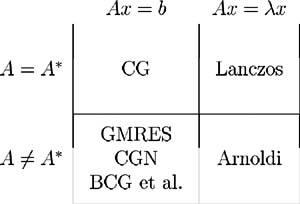
On p. 245 we presented a table of Krylov subspace matrix iterations:

Our discussions of three of these boxes are now complete, and as for the fourth, lower-left position, we have already discussed GMRES. In this lecture we turn to the final two lines of the table. We spend just a moment on CGN, a simple and easily analyzed algorithm, and then move to our main subject, the biorthogonalization methods represented by the entry "BCG et al."

CGN = CG Applied to the Normal Equations

Let be nonsingular but not necessarily hermitian, so that Ax = b, for any , is a nonsingular square system of equations. One of the simplest methods for solving such a system is to apply the CG iteration to the normal equations (11.9),


(The matrix A* A is not formed explicitly, which would require m 3 flops. Instead, each matrix-vector product A* Av is evaluated in two steps as A*( Av).) Since A is nonsingular, A* A

UNLIMITED FREE
ACCESS
TO THE WORLD'S BEST IDEAS

SUBMIT
Already a GlobalSpec user? Log in.

This is embarrasing...

An error occurred while processing the form. Please try again in a few minutes.

Customize Your GlobalSpec Experience

Category: Field-Programmable Gate Arrays (FPGA)
Finish!
Privacy Policy

This is embarrasing...

An error occurred while processing the form. Please try again in a few minutes.