Optical Document Security, Third Edition
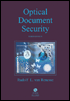
Containing over 150 illustrations, including actual security documents, this book delivers a comprehensive and cohesive treatment of all aspects of optical document security.
 TABLE OF CONTENTS
 The passport is a human being's noblest part. It comes into being much less simply than people themselves do. A human being can come into the world anywhere, in the most careless way; but a passport, never. For that reason it is recognized when it is good, whereas a human being can be very, very good yet go unrecognized.
Bertolt Brecht
Biometrics is often believed to be about personal identity. However, personal identity is an extremely complex philosophical problem, touching fundamental questions such as "who am I?" and "what am I?" Biometrics by no means considers such questions and, therefore, is not about personal identity at all, although the notions "identity" and "identification" are frequently used in biometrics.
Biometrics, in the context of this chapter, is about the automated authentication of physical and physiological personal attributes. Consider a criminal having fingerprints "exactly" matching yours. A court will probably verdict that you are him. But even if the matching of your fingerprints with those of a criminal is considered conclusive legal evidence of you having committed the crime, having your fingerprints is not what it is for some past or future being to be you [1].
All documents have the intrinsic function of granting their bearers certain rights. These rights, for example, comprise the right to access premises or computer databases (admission tickets, press cards, swipe card, identification card), to cross a border (passport, visa), to use a public telephone system (telephone...